

Hiring a contractor shouldn't feel like a gamble, but for many Western Colorado homeowners, it does.
Between out-of-state companies that disappear after taking deposits, unlicensed handymen working under the table, and high-pressure salespeople pushing unnecessary work, finding a trustworthy contractor can feel overwhelming.
We've worked in Rifle, Glenwood Springs, Aspen, and Carbondale for 57 years. We've seen what bad contractors do to homeowners in this area, and we've helped clean up their messes more times than we'd like to count.
The good news? Bad contractors follow predictable patterns. Once you know what to look for, they're easy to spot and avoid.
Here are the red flags that should send you running, and the green flags that indicate you've found someone trustworthy.
Red Flag #1: No Local Address or Established Presence
If you can't verify where a contractor is actually based, that's a problem.
What to Watch For
- Out-of-state phone numbers or addresses (especially after major storms like hail)
- P.O. boxes instead of physical business addresses
- Generic company names like "Colorado Roofing Solutions" or "Mountain Home Services" with no local history
- No Google Business Profile or online presence beyond a basic website
Why It Matters
Contractors without local ties have no accountability. If something goes wrong six months after they finish your job, good luck tracking them down.
Storm chasers are particularly common after hailstorms. They flood Western Colorado, sign contracts quickly, do subpar work, and disappear. When your roof leaks the following spring, there's no one to call.
What to Do Instead
Look for contractors with:
- Physical business addresses in Western Colorado (Rifle, Glenwood Springs, Carbondale, Aspen)
- Established Google Business Profiles with years of reviews
- Local references you can verify
- History in the community (family-owned businesses, long-term presence)
A contractor who lives here has skin in the game. Their reputation depends on quality work because they'll see you at the grocery store, the gas station, and local events.
Red Flag #2: Pressure to Sign Immediately
Legitimate contractors don't use high-pressure tactics. Bad ones do.
What to Watch For
- "This price is only good if you sign today"
- "We have a crew in the area this week only"
- "Your roof is an emergency; we need to start tomorrow"
- Discounts for signing on the spot
Why It Matters
Pressure tactics exist to prevent you from doing research, getting competing bids, or thinking clearly about the decision.
Roofing, HVAC, and plumbing work are significant investments. You deserve time to evaluate options, verify credentials, and make an informed choice.
What to Do Instead
Any contractor worth hiring will:
- Give you time to review the proposal
- Encourage you to get multiple bids
- Provide written estimates with clear scope, timeline, and pricing
- Answer questions without rushing you
If they're pressuring you, they're not confident you'll choose them once you do your homework. That tells you everything.
Red Flag #3: Cash-Only or Large Upfront Deposits
Payment terms reveal a lot about a contractor's legitimacy and financial stability.
What to Watch For
- Cash-only payments (no paper trail)
- Requests for 50% or more upfront before work begins
- Pressure to pay in full before project completion
- Reluctance to provide itemized invoices or receipts
Why It Matters
Legitimate contractors accept checks, credit cards, or financing. They have business bank accounts, insurance, and proper accounting.
Cash-only contractors are often working under the table to avoid taxes, licensing requirements, or insurance obligations. If something goes wrong, you have no recourse.
Large upfront deposits are red flags for two reasons:
- The contractor may be financially unstable and using your deposit to pay for previous jobs
- You lose leverage if work quality declines or the contractor abandons the project
What to Do Instead
Standard payment terms for home services:
- Small deposit upfront (10–25% to secure scheduling and order materials)
- Progress payments tied to milestones (e.g., 50% at midpoint, remaining balance upon completion)
- Final payment due only after work is complete and inspected
Never pay in full before the job is done. And always get receipts.
Red Flag #4: No License, Insurance, or References
Operating legally isn't optional. Contractors must carry proper licensing and insurance to protect you.
What to Watch For
- Refusal to provide proof of insurance (general liability and workers' compensation)
- No contractor license (required in Colorado for jobs over $500)
- "We don't need insurance; we're careful" (absolutely false)
- No references or reluctance to provide them
Why It Matters
If an unlicensed, uninsured contractor injures themselves on your property, you're liable. If they damage your home, you have no recourse.
Workers' compensation insurance protects you if a worker gets hurt. General liability insurance covers property damage caused during the job. Both are non-negotiable.
What to Do Instead
Before hiring any contractor, verify:
- Colorado contractor license (check at dora.colorado.gov)
- Proof of general liability insurance (ask for certificate of insurance)
- Workers' compensation insurance (required if they have employees)
- At least three local references you can contact
Call those references. Ask about work quality, timeline, communication, and whether they'd hire the contractor again.
Red Flag #5: Verbal Estimates Without Written Contracts
Handshake deals feel neighborly, but they leave you vulnerable.
What to Watch For
- Estimates given verbally with no written documentation
- Contracts that lack detail (vague scope, no timeline, unclear payment terms)
- "We'll figure out pricing as we go"
- Missing project scope or materials specifications
Why It Matters
Without a written contract, you have no legal protection if:
- The contractor changes pricing midway through the job
- Work quality doesn't match what was discussed
- The project timeline drags on indefinitely
- Disputes arise about what was agreed upon
Verbal agreements are unenforceable. Written contracts protect both parties.
What to Do Instead
A proper contract should include:
- Detailed scope of work (exactly what's being done)
- Materials specifications (brands, grades, quantities)
- Project timeline (start date, estimated completion)
- Payment schedule (deposit, progress payments, final payment)
- Warranty information (labor and materials)
- Permit details (if required)
If a contractor resists putting things in writing, they're either inexperienced or planning to take advantage of you.
Red Flag #6: Suspiciously Low Bids
If a bid seems too good to be true, it probably is.
What to Watch For
- Bids significantly lower than competitors (30–50% below market rate)
- "We can do it cheaper because we buy materials in bulk" (not how it works)
- Cutting corners to reduce costs (skipping permits, using substandard materials)
Why It Matters
Quality work costs money. Materials, labor, insurance, and overhead all factor into legitimate pricing.
Contractors bidding far below market rate are either:
- Using inferior materials you didn't agree to
- Planning to cut corners (skipping steps, doing shoddy work)
- Uninsured or unlicensed (reducing overhead by operating illegally)
- Planning to upsell mid-project (lowball to win the job, then inflate costs with "unexpected issues")
What to Do Instead
Get at least three bids from reputable contractors. Prices should be reasonably close (within 10–20% of each other).
If one bid is drastically lower, ask why. What's different about their materials, timeline, or scope? If they can't give a clear answer, walk away.
Remember: Cheap work costs twice. You'll pay again to fix it.
Red Flag #7: Poor Communication or Unprofessional Behavior
How a contractor treats you before the job reflects how they'll treat you during and after.
What to Watch For
- Missed appointments without notice
- Unreturned calls or emails for days
- Vague, evasive answers to direct questions
- Unprofessional appearance or conduct (showing up intoxicated, using offensive language)
- Badmouthing competitors excessively
Why It Matters
Communication problems before the job only get worse during the job. If they're unreliable now, they'll be unreliable when you need updates, have concerns, or require warranty work.
Professionalism matters. You're inviting these people onto your property and trusting them with a significant investment.
What to Do Instead
Work with contractors who:
- Respond to inquiries within 24–48 hours
- Show up on time for appointments
- Communicate clearly and respectfully
- Provide updates proactively during projects
- Address concerns professionally
You're not being picky. You're protecting your home and your wallet.
Green Flags: Signs You've Found a Good Contractor
Now that you know what to avoid, here's what to look for.
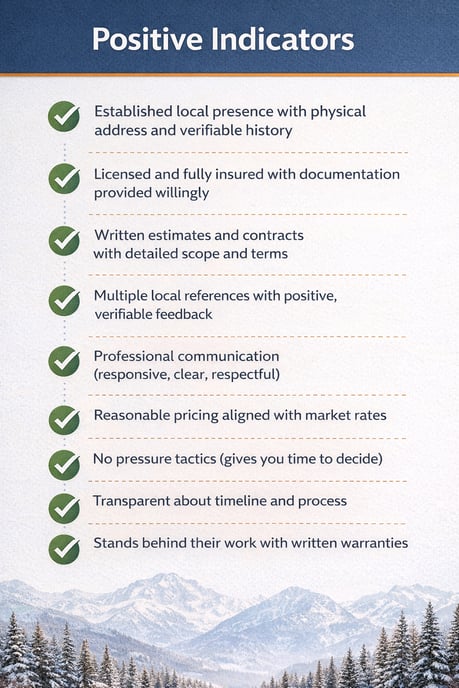
If a contractor checks these boxes, you're in good hands.
What to Do If You've Already Been Burned
If you've hired a bad contractor and now face incomplete work, poor quality, or financial loss, you have options.
Steps to Take
- Document everything: Photos, emails, texts, contracts, receipts
- Send written notice: Certified letter outlining issues and requesting resolution
- File complaints:
- Colorado Department of Regulatory Agencies (DORA)
- Better Business Bureau (BBB)
- Local consumer protection agencies
- Consult an attorney: For significant financial loss or property damage
- Report unlicensed contractors: Help protect other homeowners
It won't undo the damage, but it may prevent others from being victimized.
How Pacific Operates Differently
We've been serving Western Colorado since 1968. Three generations of our family have built this business on honesty, quality, and accountability.
Here's how we operate:
- We're local: 80 Gemat Circle, Rifle, CO. We've been here for 57 years.
- We're licensed and insured: We'll provide documentation without you asking.
- We give written estimates: Clear scope, timeline, pricing—no surprises.
- We don't pressure you: Take your time, get other bids, make the right choice.
- We stand behind our work: Written warranties, responsive service, no disappearing acts.
We see our customers at the grocery store, at kids' sports games, and around town. Our reputation is everything.
Call Pacific at 970.989.9973 or schedule a free consultation. Experience what honest, professional contractors look like.
FAQs: Hiring Contractors in Western Colorado
How do I verify a contractor's license in Colorado?
Visit the Colorado Department of Regulatory Agencies (DORA) website and search their contractor license database. All licensed contractors must be registered.
What insurance should a contractor have?
General liability insurance (covers property damage) and workers' compensation insurance (covers employee injuries). Ask for certificates of insurance before work begins.
How many bids should I get before hiring a contractor?
At least three bids from reputable, licensed contractors. This gives you a sense of market pricing and helps you compare approaches.
Is a verbal agreement legally binding?
Verbal agreements are difficult to enforce. Always get written contracts with detailed scope, pricing, timeline, and payment terms.
What should I do if a contractor asks for full payment upfront?
Don't pay it. Standard terms are 10–25% deposit, progress payments, and final payment upon completion. Full payment upfront is a red flag for fraud or financial instability.
How can I tell if a bid is too low?
If one bid is 30–50% below others, ask why. Legitimate low bids have clear explanations (different materials, smaller scope). Vague answers or deflection are red flags.